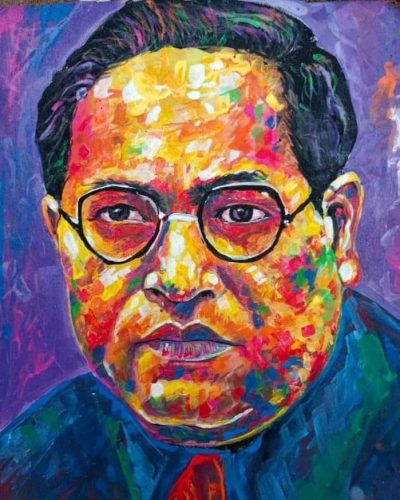
Early Life and Formative Years
Dr. Bhimrao Ramji Ambedkar was born on April 14, 1891, in the military cantonment town of Mhow, located in the Central Provinces (now Madhya Pradesh). He was the 14th and last child of his parents, Ramji Maloji Sakpal and Bhimabai Sakpal. His father, a Subedar-Major in the British Indian Army, instilled in him a deep sense of discipline and the importance of education, a rare privilege for children from the Mahar (Dalit) community. From a very young age, Ambedkar experienced the harsh realities of untouchability. He and his siblings were forced to sit outside the classroom, were not allowed to touch the water tap, and were ostracized by their peers and teachers. These early encounters with discrimination fueled his lifelong determination to dismantle the caste system.
His formal education began in Satara and later in Mumbai, where he was the only "untouchable" student in his class. He faced daily humiliation but persevered. His academic brilliance was recognized by the Maharaja of Baroda, Gaekwad, who awarded him a scholarship for higher studies abroad. This patronage was a turning point. In 1913, Ambedkar embarked on his journey to the United States to study at Columbia University in New York.
At Columbia, he pursued economics, political science, and sociology with immense dedication. He earned his M.A. in 1915 with his thesis, "Ancient Indian Commerce." His groundbreaking Ph.D. dissertation, "The Evolution of Provincial Finance in British India," earned him a doctorate in 1917. Following his time in New York, he moved to London to study at the London School of Economics (LSE) and to pursue a law degree at Gray's Inn. His intellectual prowess was unparalleled, and his research laid the foundation for his later work in economic policy and social justice.
Political Awakening and Social Activism
After completing his education and returning to India, Ambedkar's primary focus shifted to the liberation of the oppressed. He realized that a purely academic approach was not enough to challenge the deeply entrenched caste system. He became a fierce social reformer and a powerful voice for the voiceless.
In 1924, he founded the **Bahishkrit Hitakarini Sabha (Depressed Classes Welfare Association)** with the motto, "Educate, Agitate, Organize." This organization was his first major step in creating a platform to raise awareness about the injustices faced by Dalits. He launched several periodicals, including **'Mooknayak' (Leader of the Voiceless)** in 1920 and **'Bahishkrit Bharat' (Excluded India)** in 1927, to articulate the demands and struggles of his community.
A landmark event in his activism was the **Mahad Satyagraha of 1927**. Ambedkar led thousands of Dalits to the Chavadar Tank in Mahad, Maharashtra, to drink water from a public source, a right denied to them. When upper-caste Hindus purified the tank afterward, Ambedkar and his followers burned copies of the **Manusmriti**, the ancient Hindu text that codified social hierarchies and justified untouchability. This act was a powerful symbolic rejection of the caste system itself. Another significant struggle was the **Kalaram Temple Entry Movement** in Nashik, which sought to grant Dalits the right to worship in Hindu temples.
The Round Table Conferences and Poona Pact
Ambedkar's stature as a leader for the depressed classes was globally recognized. He was invited to all three **Round Table Conferences** (1930-1932) in London to discuss constitutional reforms in India. During these conferences, he strongly advocated for separate electorates for the depressed classes, arguing that their interests would not be adequately represented by the Congress or other political parties.
His demand for separate electorates led to a significant disagreement with Mahatma Gandhi. Gandhi, believing that this would permanently divide the Hindu community, went on a fast unto death in Yerawada Jail. To prevent Gandhi's death, Ambedkar entered into negotiations, which culminated in the **Poona Pact of 1932**. Under this agreement, Ambedkar dropped the demand for separate electorates in exchange for a significant increase in the number of reserved seats for the depressed classes in provincial and central legislatures.
Architect of the Indian Constitution
Following India's independence in 1947, Ambedkar was appointed as the country's first Law Minister in Jawaharlal Nehru's cabinet. His legal expertise and deep understanding of social and political issues made him the natural choice to serve as the Chairman of the **Drafting Committee of the Indian Constitution**. He meticulously worked on the document, ensuring that it was rooted in the principles of liberty, equality, and fraternity.
The Constitution of India, largely shaped by his vision, is a testament to his commitment to social justice. Key provisions that he championed include:
- Fundamental Rights: He ensured that basic human rights were guaranteed to every citizen, providing legal protection against discrimination.
- Abolition of Untouchability: Article 17 of the Constitution explicitly abolishes untouchability and makes its practice a punishable offense, directly addressing the social evil he fought against his entire life.
- Reservations: He advocated for reservations for Scheduled Castes and Tribes to provide them with a path to social and economic upliftment, ensuring their representation in education and government jobs.
His vision for a secular, democratic, and socially just India is enshrined in the Constitution, making him a true founding father of the nation.
Conversion to Buddhism and Final Years
Despite his immense contributions, Ambedkar became increasingly disillusioned with Hinduism, believing that its social structure was inherently biased against the lower castes. On October 14, 1956, he took a monumental step by converting to **Buddhism** in a public ceremony in Nagpur, along with nearly 500,000 of his followers. He saw Buddhism as a rational, egalitarian, and compassionate religion that offered a way out of the oppressive caste system. His final book, **'The Buddha and His Dhamma'**, published posthumously, laid out his interpretation of Buddhist principles.
Dr. B.R. Ambedkar passed away a few months later on December 6, 1956. He was posthumously awarded the **Bharat Ratna**, India's highest civilian honor, in 1990. His legacy as a jurist, economist, politician, and social reformer continues to inspire millions in India and around the world. He is affectionately remembered as "Babasaheb," the respected father of the Indian Constitution and a tireless champion of the oppressed.